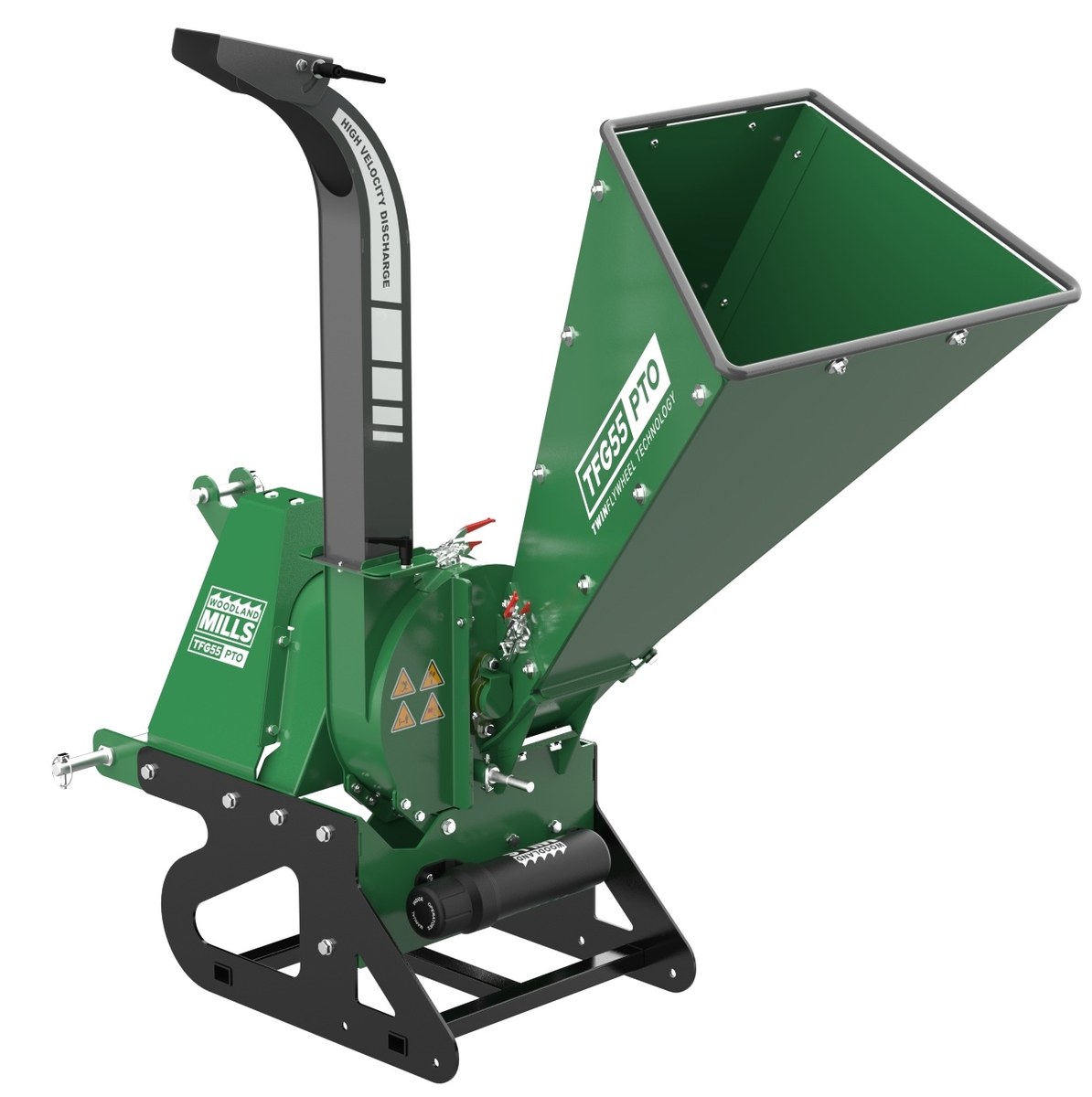
Farmry WCAP5 PRO vs Woodland TFG55 PTO: two 5-inch gravity chippers
Both are gravity-fed 5-inch chippers, but their drive layouts and discharge choices differ. WCAP5 PRO uses a speed-increasing gearbox and a 5 × 8-inch cutting opening. TFG55 PTO separates chipping and throwing between two flywheels and uses a 5 × 5-inch opening. Compare those handling details after resolving each manual’s conflicting horsepower paragraph.
By Acreage Equipment · Reviewed November 8, 2026 · Specification research, not a field test
Consider WCAP5 PRO for its wider rectangular cutter openingShortlist the Farmry when the 5 × 8-inch opening and two discharge directions suit the branch pile and work area.
Consider TFG55 for its discharge choices and twin-flywheel layoutShortlist TFG55 when four documented discharge positions and separate cutting/throwing flywheels answer the job.
Prices shown on the product cards retain their original check dates. Prices were not refreshed for this comparison, and no purchase-cost ranking is made. Request current itemized quotes for the exact configuration, shaft, setup and delivery. Open your saved comparison →
The differences that matter.
01
Resolve the power band before comparing capacity
WCAP5 PRO: its Category 1 paragraph specifies 15–45 PTO hp, while the Category 1N paragraph says 20–50 PTO hp. TFG55 PTO: the current page specifies 12–30 PTO hp and the manual table lists a 12 PTO hp minimum; its hitch paragraph instead says 15–30.
For a tractor below 15 PTO hp, TFG55’s lower table number needs manufacturer confirmation. For a tractor above 30 PTO hp, the Farmry range is a reason to investigate the exact hitch configuration, not permission to ignore its conflicting paragraph.
Different mechanisms drive the cutting and throwing
WCAP5 PRO uses a gearbox, with 540 rpm maximum PTO input and 1,080 rpm maximum disc speed. TFG55 uses belts and two flywheels: its page describes the chipping flywheel at just over 540 rpm and the throwing flywheel above 1,080 rpm. Both retain gravity feeding.
This changes the parts and service layout to inspect: gearbox oil on Farmry, and the separate belt-driven flywheels on TFG55. These speeds do not establish comparative throughput, throwing distance or powered feed; disc speed is not the tractor PTO setting.
WCAP5 PRO’s current page distinguishes a 5 × 8-inch cutter opening from a 17 × 23-inch hopper opening and lists two moving knives. TFG55 has a 5 × 5-inch cutting opening; its manual lists a 27-5/8 × 17-3/16-inch infeed chute and three blades.
For forked or bushy material, the path into the cutter matters alongside trunk diameter. Compare actual branch shapes with the seller. The long side of Farmry’s rectangle is not an 8-inch round-log rating, and blade count alone does not rank speed or chip quality.
WCAP5 PRO specifies two discharge orientations, 0° and 180°. TFG55 describes 360° rotation in 90° increments plus an adjustable deflector.
TFG55 offers more documented directions to investigate when the tractor cannot be repositioned easily. Farmry may suit a layout needing its two stated directions. Confirm the allowed collection positions and clearances; neither description establishes a measured throwing distance.
Confirm the hitch package rather than the broad marketing claim
WCAP5 PRO’s table/manual list Category 1N and 1, and the manual documents included lower-pin quick-hitch adapters. Its marketing also mentions Category 2, which those specifications do not establish. TFG55 documents Category 1 and lists its PTO shaft, two quick-hitch adapters and adapter flanges in the component list.
Have the quote identify the pins and adapters for the actual tractor. The TFG55 shaft is trimmable and shear-protected; both installations still require length, overlap and clearance checks, especially with a quick hitch.
WCAP5 PRO lists 386 lb product weight and 434 lb shipping weight. TFG55’s manual distinguishes 346 lb product weight from 454 lb shipping weight, although its web shipping section labels 346 lb as shipping weight. Neither product-weight entry clearly establishes the complete shaft-inclusive operating load.
The product and shipping figures point in different directions, so a single lighter/heavier verdict would mislead. Obtain complete assembled loads for tractor planning and confirmed crate loads for unloading.
Consider WCAP5 PRO for its wider rectangular cutter opening
Shortlist the Farmry when the 5 × 8-inch opening and two discharge directions suit the branch pile and work area. Confirm which PTO band applies to the exact Category 1 or 1N setup, then review gearbox service and the complete installed load. Do not select it on an unverified claim of faster chipping.
Consider TFG55 for its discharge choices and twin-flywheel layout
Shortlist TFG55 when four documented discharge positions and separate cutting/throwing flywheels answer the job. Confirm the 5 × 5-inch opening suits the material and resolve the 12-versus-15 PTO-hp minimum before relying on the smaller-tractor range.
WCAP5 PRO has conflicting explicit PTO ranges: 15–45 for Category 1 on p21 and 20–50 for Category 1N on p22. Its generic 15–45 HP table and 50-HP gearbox rating do not resolve the tractor requirement.
TFG55’s page uses 12–30 PTO hp and manual p9 lists a 12 PTO hp minimum, while p11 specifies 15–30. The published 12-hp screen is retained as a reference with mandatory review; this comparison does not claim a verified match below 15.
WCAP5 PRO marketing mentions Category 2, but its specification table and manual establish Category 1N/1. Manual p13 labels the 5 × 8 opening as feed hopper and 17 × 23 as housing, while the page distinguishes cutter and hopper in the opposite way; the marketing metric/inch line is also inconsistent.
TFG55 web shipping text says 346 lb; manual p9 says 346 lb product and 454 lb shipping. Neither model’s product weight clearly includes the actual shaft and every operating item.
Official product pages were reviewed on November 8, 2026. Manual references are Farmry WCAP5 PRO Rev 1.4 and Woodland Mills TFG55 PTO Rev B, dated October 15, 2024. Conflicting specifications are identified below.
FOLLOW THE NUMBERS
Sources & documentation
Research record reviewed November 8, 2026. Confirm the current manual and the exact revision supplied with your machine.