THE ACREAGE EQUIPMENT FIELD GUIDE
Fixed vs. hydraulic side-shift flail mowers
A wider cutter and a cutter that moves sideways solve different problems. Width changes the swath in one pass; side shift changes where that swath sits relative to the tractor. Start by identifying the edge you need to reach and the wheel track you still need to cover, then check the additional hydraulic circuit, clearance and load requirements.
By Acreage Equipment · Reviewed November 7, 2026 · Specification research, not a field test
THE DECISION IN NUMBERS
Worked coverage example: wider is different from shifted
Illustrative arithmetic, not a TFMS50 installation drawing or fit approval. Tire span is an assumed 54 inches; each cutter starts centered. The seven-inch shift is an example only. Negative coverage is stated as an uncovered part of the outside-to-outside tire span; actual tire widths, offset limits and attachment geometry must be measured. Product sources below explain width versus travel, not the hypothetical tractor dimensions.
Scroll the table sideways on smaller screens.
| Illustrative setup | Cut in one pass | Left edge vs. tire span | Right edge vs. tire span |
|---|---|---|---|
| 61-inch cutter, centered | 61 in | 3.5 in beyond left edge | 3.5 in beyond right edge |
| 49-inch cutter, centered | 49 in | 2.5 in inside left edge | 2.5 in inside right edge |
| Same 49-inch cutter, shifted 7 in right | 49 in | 9.5 in inside left edge | 4.5 in beyond right edge |
Sources for this decision table (2)
Ask whether the problem is coverage or reach
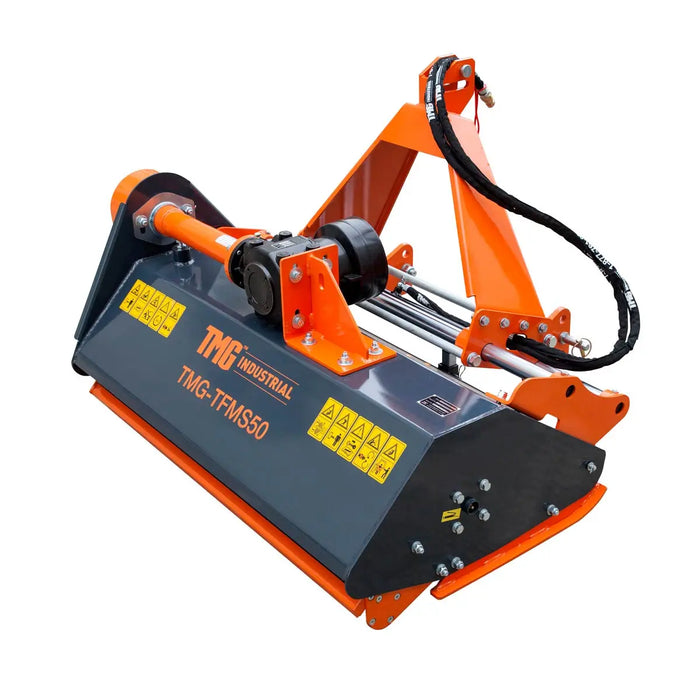
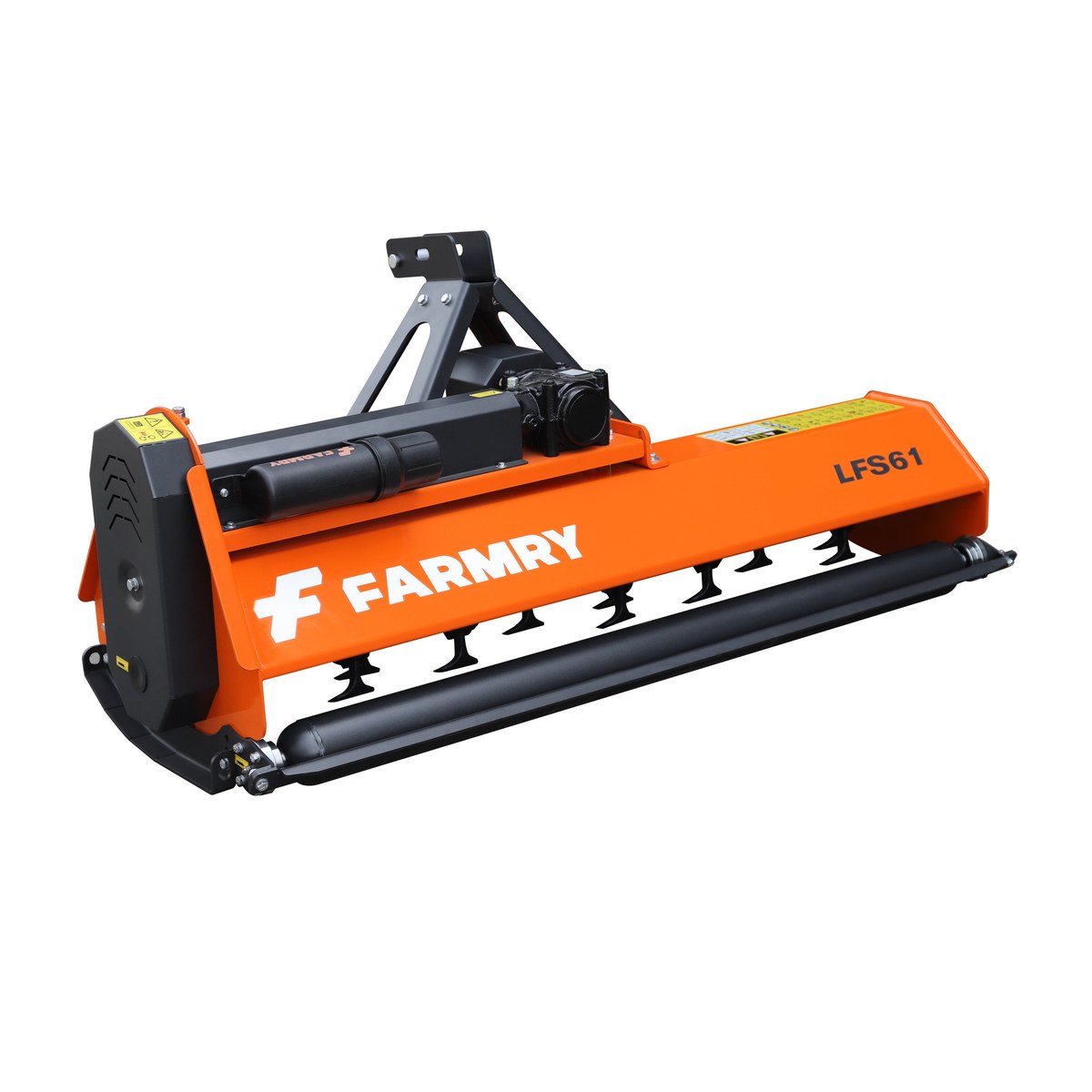
A fixed mower may suit a broad mowing path when its cut and mounted position provide the coverage you need. Farmry LFP47 lists a 47.2-inch cut and no hydraulic ram. TFMS50 lists a 49-inch cut and about 14 inches of side shift. That TMG feature can change lateral position; it does not turn the deck into a 63-inch cutter. Nor does side shift establish that the deck articulates for ditch-bank work or that the tractor may operate on a particular slope.
Moving right gives up coverage on the left
The worked table assumes a 54-inch outside tire span and an initially centered cutter. A hypothetical 49-inch cut begins 2.5 inches inside each outside tire edge. Moving that cutter seven inches right gives 4.5 inches beyond the right tire edge while leaving 9.5 inches of the left side of the tire span outside the cut. Its one-pass cut is still 49 inches. These are geometry examples, not dimensions or permitted positions for a specific tractor. The TFMS50’s 14-inch travel figure does not establish seven inches in each direction from the tractor centerline.
Three-point lift and a rear remote do different jobs
A fixed rear mower still needs the tractor’s three-point lift. TFMS50 additionally documents a side-shift cylinder and two hoses. The reviewed sources do not establish its required flow, pressure, valve arrangement or tractor quick-coupler type. A G1/2 adaptor in the parts list is not a complete tractor-coupler specification. Ask TMG for the circuit requirements and check the valves actually installed on your tractor.
A hydraulic brochure number does not finish the check
The LX2620’s 8.7 gpm figure is total pump output; the base KIOTI CK20 brochure shows rear remotes as optional. Neither statement establishes a suitable installed side-shift circuit. Record the tractor’s actual rear-remote flow and pressure, required valve function and couplers when the manufacturer supplies the implement requirements. Avoid selecting a hydraulic mower from an engine-horsepower badge or total-pump number alone.
Request clearance and operating-load information at the intended position
TFMS50’s listed operation weight is 660 lb; LFP47’s 464 lb figure explicitly includes its shaft. Their inclusion bases differ, so the numerical difference is not a verified installed-weight saving. Ask for the complete operating package and clearance through the allowed offset and hitch travel, including the driveline and hoses. Compare a fixed deck if it already reaches the working edge; investigate side shift when controlled lateral positioning addresses a measured need.
Take these questions with you.
- What are the cutter’s left and right edges relative to my tractor centerline at each allowed position?
- What remote valve function, flow, pressure and tractor couplers does this exact side-shift mower require?
- Does the complete operating package clear the tires, hitch, hoses and PTO shaft throughout permitted movement?
Keep these questions with your exact tractor and attachment details.
Use these questions in my seller briefFOLLOW THE NUMBERS
Sources & documentation
Research record reviewed November 7, 2026. Confirm the current manual and the exact revision supplied with your machine.
- Farmry LFP47 Pro Series Y-blade flail mower official U.S. product page — Specifications → RAM (NO); weight includes PTO shaft; Product Features → Y-blades
- Farmry LFP47 Pro Series Y-blade flail mower operator manual — LFP Rev 1.3, printed p17 / PDF p18 tractor HP and width; printed p18 / PDF p19 hitch/weight/rotor
- TMG Industrial TFMS50 hydraulic side-shift flail mower official U.S. product page — Specifications → 49-inch working width, 14-inch shift and 660 lb operation weight; Product Description
- TMG Industrial TFMS50 hydraulic side-shift flail mower operator manual — 2025-01-09 manual: PDF p6 tractor requirements; p10 cylinder/pipes; p15 TFMS50 table; pp19–20 hoses/adaptors
- Kubota LX20 specifications — Printed pp14–15 specification spread: LX2620 total pump output 8.7 gpm
- KIOTI CK20 / CK20SE U.S. brochure — Printed p6, base CK4020 and CK4020H columns: gross-engine HP, PTO HP, hitch, lift at 24 inches, rear remotes
- Farmry official product specifications
- Farmry LFS Series operator manual, Rev 1.7 — Printed pp17–18 specifications; p28 tractor stability
- Farmry flail mower comparison table — Net-weight comparison; may exclude PTO shaft
- Official FM-54 page: Y option, displayed price, shaft and weight
- FM-54 manual for 2025-and-newer models, p40 specifications
- Current manual index: FM-54 under Models 2025 to current